Older Dogs and their Health
29 May 2010Hi there, I’m back after a long layoff from this blog for no better reason than I just have been too busy with other projects that pay the bills and allow me to earn my living online. Anyhow, that’s of no real concern here, this is a blog about dogs and not about money, although you do need some to ensure your dogs are kept in the best of health. And that sort of leads me onto what I wanted to write about here. not so much the health of your dog, but more on their health as they get older.
Chelsea was the ripe old age of 11 when she died, which I’m told is not bad for a German Shepherd, although I’m sure that there were probably things I could have done to prolong that life a little longer. But would it have been wise? She was already feeling her age and with arthritis causing her pain in her hips, would it have been cruel to keep her going for longer? Tough question and there is probably no right answer. It would be down to personal feelings. Given the choice, I probably would have done – but I didn’t have the choice. I can console myself that she had an amazing life while she was here, growing up in England and then spending the last few years of her life on a beautiful mountain farm in southern Spain, free to run around and no one to threaten her (or me) because of social changes in the attitude towards large dogs.
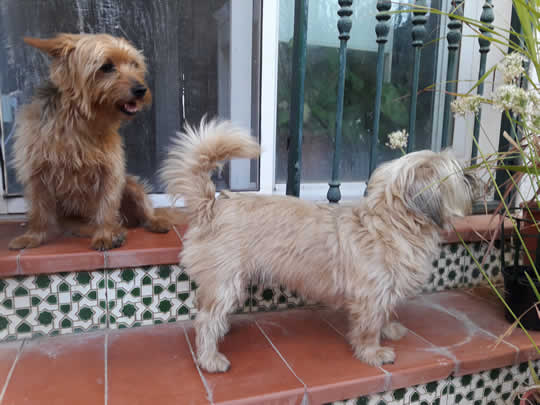
So we move on a few years and you probably already know (if you have been reading this blog) that I have sort of inherited two Yorkies of advancing age. The girl, Daisy is 14 now and the boy, Ronnie (who is a cross and was a rescue dog) is estimated to be 13. They are both in reasonably good health for their age (Yorkies generally live longer than German Shepherds), although Daisy is less keen to go for walks now and sleeps a lot more. Ronnie is a total loco – he doesn’t know he’s old and still bounds around like a puppy. Not sure if that’s a good thing or not. I like to think that it is, because we all know you are only as old as you think you ar, and the same must go for dogs.
So what has kept them so healthy?
Well, the standard answer applies here. They have always eaten decent food, very little “human” snacks, they have always had plenty of exercise and live in a calm, happy home.
In fact, I believe a lot of a dog’s health has to do with its environment. When a dog lives in a home where there are always arguments, stress and a tense, negative atmosphere, the dog gets stressed too. Stress is a killer and if it doesn’t kill right away, it is a catalyst for a slow degenerative state of health. On the flip side, a dog in a loving, happy home where people are always laughing and the atmosphere is always calm, relaxed, peaceful and positive then they will enjoy better health, just like we do.
So aside from the regular visits to the vet to get their jabs, a regular de-parasiting and being fed well, I believe if your dog(s) live in a happy home, they will live longer, healthier lives. I think it probably also helps to be a little loco too…
Barking Dogs
20 October 2009Welcome back to another of these rare posts! Ok, they’re getting scarcer but there are over 50 posts stored in here now, so I think there’s enough to keep anyone reading into the wee small hours! Anyway, this post is going to be about barking dogs and how they can be a nuisance to some people and a comfort to others.
When you live in an enclose street, or in a small estate where building face onto each other dogs barking can echo around the place and amplify to levels that can be annoying especially to those people who are not dog lovers (yes, such an entity exists amongst us real humans!). There’s not much you can do about it without taking drastic and what would end up being hugely unpopular action, so how can the problem be minimised or at least restricted so that its not going on all day.
As you know, when one dog starts, another joins in and then another until you have a cacophony of barks, yaps, howls and growls all going on at once! As one dog stops, a new one starts so this can go on for a while!
To minimise the problem, you could try keeping your dog indoors when you’re not at home. I know that is probably what most dog owners do anyway, but there are plenty who leave their dogs in the back yard or garden while they’re out. Why they should want to do this is odd – surely you’d want your home’s best chance of warding off a potential house breaking burglar to be inside where he’ll do the most good and not outside where he is ineffective! But then some people simply don’t think along those lines, until they’re broken into and their dog is barking his head off out in the yard where the burglar, from an upstairs window is giving it the finger as he rifles through your stuff.
Of course, a barking dog is supposed to deter a burglar and its true. But when there are several dogs barking away at once and they’re all outside, people get immune to the noise and ignore the warning that one of those poor dogs is trying to give.
Still want to keep your dog outside?
A dog inside the house is much more effective as an anti-burglar device because no self respecting burglar is keep to go head to head with the jaws of a snarling, angry dog, especially if its a big one! Any burglar faced with a house containing a dog will usually skip it and go next door (to the house who’s owner thinks its better to keep the dog chained up in the back yard). With nothing in the house to give him any trouble, your average burglar is going to get in, trash your home, steal what he can, smash up what he can’t and probably throw the contents of your fridge at the dog through the kitchen window just to show he’s probably a bigger dog lover than you are!
So, next time you’re being driven mad by the local dog chorus, spare a thought for why they’re all barking. Maybe, just maybe one of your neighbours is being burgled while you’re cursing at his dog for making so much noise. Of course, if you spot one back yard dog who suddenly stops barking and starts eating, you have probably found the culprit and where it all started from!

.gif)